My Public Transport Odyssey: A Hilarious Journey Through Korea's Subways, Buses, and My Own Existential Dread
Honestly, I've always considered myself a relatively competent human being. I can assemble IKEA furniture with only *some* tears, I can parallel park on a good day, and I once successfully navigated a particularly aggressive pigeon in Trafalgar Square without losing an eye. So, naturally, when I first planned my trip to Korea, I thought, "Public transport? Pffft. I got this." Oh, my sweet, naive summer child. My initial confidence lasted about as long as a free sample at a department store - gone in a flash, leaving me vaguely dissatisfied and wondering what just happened.
Look, Korea's public transport system is, objectively, a marvel. It's efficient, clean, often ridiculously fast, and puts many other developed nations to shame. But for a first-timer, especially one whose internal compass is permanently set to "mildly confused," it can feel less like a well-oiled machine and more like a high-stakes game of Twister played inside a pinball machine. With added social pressure. And no prize for participation, just the sweet relief of arriving at your destination. Eventually. This isn't just a guide; it's a therapeutic recounting of my own trials and triumphs. Mostly trials, if we're being honest.
The Grand Overture: My First Dance with the T-Money Card
Here's the thing about public transport in Korea: it all starts with the T-Money card. This isn't just a payment method; it's your golden ticket, your magic wand, your entry pass into a world of seamless travel. Or, at least, that's what the cheerful signs told me. My first encounter with a T-Money card was back in 2017, during a particularly sweltering August. I'd heard about it, seen YouTube videos, felt adequately prepared. I strolled into a convenience store, confidently pointed at the display, and, with a flourish that I now realize was entirely unearned, purchased my very first T-Money card. I even opted for one with a cartoon character on it - a bold choice for a man in his late twenties, I thought at the time.
Loading it was the next hurdle. You see, the machines are everywhere - subway stations, convenience stores - all incredibly convenient, assuming you can read Korean or figure out the often-sparse English options. My first attempt at a subway station machine went something like this: I inserted a bill, the machine beeped ominously, and then it spat my money back out. Repeatedly. I tried different denominations. More beeping, more rejection. I swear, the machine looked at me with the digital equivalent of an eye-roll. This went on for a good five minutes, during which I became increasingly aware of the growing queue behind me. You know that specific kind of shame? The one that radiates off you like bad cologne, informing everyone in a 10-meter radius that you, dear traveler, are fundamentally incompetent? Yeah, that.
Finally, a kind elderly woman, probably on her way to conquer Mount Everest or knit a new country, gently tapped my shoulder. She pointed to a tiny, almost invisible slot on the side of the machine, then to the card reader. Oh. Right. You put the *card* in first, *then* the money. My face turned a shade of crimson usually reserved for overripe tomatoes. I mumbled a thousand apologies in broken Korean, bowed so deeply I nearly headbutted the machine, and finally, finally, loaded my card. As of 2024, the process is still essentially the same, though many machines now have clearer English instructions, thankfully. But the basic principle remains: card first, then cash. Don't be like me. Don't engage in a silent, futile battle of wills with an inanimate object designed for your convenience. The T-Money card is still the undisputed champion for getting around Korea, linking up buses, subways, and even some taxis. Just make sure it's loaded. It's like a tiny, plastic guardian angel, only it doesn't offer comforting words, just a satisfying "beep" when you tap off.
Subway Shenanigans: A Labyrinth of Lights and Occasional Panic Attacks
Now, the Seoul subway system. Oh, the Seoul subway system. It's a masterpiece of urban planning, a sprawling subterranean network that can whisk you from one end of the gargantuan city to another with breathtaking speed. With over a dozen lines (and more always being added!), it feels like the city's circulatory system, pumping millions of people to their destinations daily. It's also where I had my second major crisis of confidence, approximately three days into my trip.
My mission: get from Anguk Station to Gangnam Station. Seems straightforward enough, right? Two major, iconic spots. My plan involved a transfer. Easy peasy. Or so I thought. I meticulously checked the map, memorized the color of the line, and confidently strode onto the train. The ride was smooth, the train surprisingly quiet despite the crowds. I was feeling smug. "Look at me," I internally congratulated myself, "a seasoned Seoul explorer!"
Then came the transfer. I got off at the designated station, looked at the signs, and promptly realized I had absolutely no idea where I was going. The station was enormous, a veritable underground shopping mall masquerading as a transit hub, filled with bustling commuters who moved with the purposeful grace of a school of fish. I, on the other hand, moved like a bewildered salmon swimming upstream, against the current, and possibly into a drainpipe. There were signs, yes, but they seemed to point in seven different directions simultaneously, and my brain, bless its cotton socks, decided to shut down.

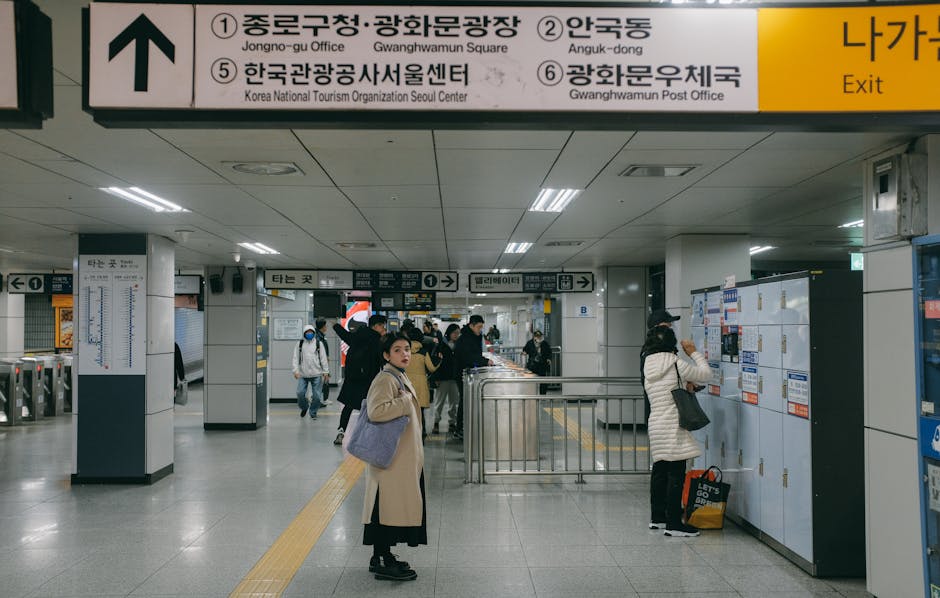
I paced. I squinted. I probably looked like a man trying to solve a particularly difficult Sudoku puzzle using only interpretive dance. For a good ten minutes, I wandered, getting increasingly disoriented, until I finally spotted a tiny, almost hidden sign that, miraculously, had the English word "Gangnam" on it, with an arrow. I followed it, feeling like Theseus finally spotting the thread out of the Minotaur's labyrinth. I made it, eventually, but not before I seriously considered just finding a bench and living out my days as a subway hermit. This was back in 2017. As of 2024, the subway system has continued to expand, and while the major stations are still vast, many have improved their English signage and even have digital displays showing arrival times in multiple languages. Thank goodness. Still, a pro tip for anyone embarking on their own Seoul subway adventure: always have a reliable map app (like Naver Maps or Kakao Maps - Google Maps is less accurate here) and don't be afraid to ask for help. Most Koreans, especially younger generations, are incredibly helpful. Just point and make a questioning face. It usually works wonders.
Bus Bonanza: When Google Maps Becomes Your Frenemy
If the subway is a complex ballet, Korean bus travel is more like an exhilarating, slightly terrifying roller coaster. It's faster for certain routes, offers fantastic street-level views, and can take you to places the subway simply can't reach. But it also requires a certain leap of faith. And a strong stomach, depending on the driver.
My first foray into bus travel happened in Busan in 2019. I wanted to go to Gamcheon Culture Village, a vibrant, colorful hillside village that looks like it's been splashed with every hue of the rainbow. Google Maps, my erstwhile travel companion, confidently directed me to a bus stop. I waited. And waited. Several buses came and went, all with numbers that were definitely *not* the one Google insisted I needed. I checked the app again. Still the same number. Had I entered the wrong destination? Was Google Maps playing a cruel joke on me? Had I offended the algorithms?
Then, I saw it. A bus, with the correct number, flew past the stop without even a flicker of brake lights. I looked around. No one else seemed bothered. Was I invisible? Was this some sort of bus-stop purgatory? Honestly, I was starting to believe it. A lady standing nearby, seeing my utterly bewildered expression, chuckled. She pointed to a specific spot about ten meters *down* the street, where there was a second, smaller sign with the same bus number. "You must wait there," she said in excellent English, smiling. "This stop is only for certain buses." Ah. Of course. The subtle nuances of Korean bus stops. It was a minor detail, but one that completely stumped me.
What I learned that day, and which still holds true as of 2024, is that while bus routes and schedules are incredibly efficient, the stops themselves can sometimes be... particular. Some stops serve multiple lines but only pick up specific ones at certain points along a longer stretch of pavement. Always pay attention to where others are standing. And prepare for a quick boarding process - the doors open, you tap your T-Money, and you move. Fast. No dilly-dallying. If you're traveling with luggage, try to avoid rush hour, because those buses fill up fast, and you'll become intimately acquainted with your fellow passengers' elbows. And honestly, for all its occasional moments of confusion, bus travel offers an unparalleled glimpse into daily Korean life, ferrying students, workers, and ajummas laden with groceries with equal aplomb. Just remember to hold on tight - those drivers mean business!
KTX: The Bullet Train and My Brief Illusion of Competence
Finally, we arrive at the KTX, Korea's high-speed rail network. This, my friends, is where I finally felt like I was winning at Korean transport. The KTX is a sleek, silver bullet that slices through the Korean landscape at speeds that would make a cheetah blush. It connects major cities like Seoul, Busan, Daegu, and Gwangju, making inter-city travel an absolute breeze. And by "breeze," I mean a wind tunnel of efficiency that gently deposits you at your destination.
Booking a KTX ticket, even as of 2024, is remarkably simple. You can do it online via the official KTX website (which has excellent English support), at the station using self-service kiosks (also with English options), or at the ticket counter. My first KTX journey was from Seoul to Busan in 2018. I had booked my ticket weeks in advance, chosen my seat, and even pre-ordered a coffee through the app (yes, that's a thing!). I arrived at Seoul Station feeling utterly sophisticated, a connoisseur of high-speed rail. I found my platform, boarded the correct car, settled into my comfortable seat, and watched the city blur into the countryside.
The KTX is ridiculously punctual. If it says it's leaving at 10:15, it means 10:15. Not 10:16, not 10:14 and a half. So, if you're the kind of person who likes to cut it close, maybe don't do that. I know, I know, I preach punctuality but sometimes my own internal clock is set to "abstract concept." Luckily, I learned my lesson early. The only real "drama" I've ever experienced on the KTX was when I mistakenly tried to board the "Economy" class car with a "Standard" class ticket. It was a brief moment of panic, where the conductor gave me a look that said, "Bless your heart, you tried," before gently pointing me two cars down. To be fair, the seating looked identical, but apparently, the universe knows the difference.
Anyway, for seamless, comfortable, and incredibly fast travel between Korea's major cities, the KTX is your absolute best friend. It's a bit more expensive than buses, sure, but the time saved and the sheer comfort make it worth every won. Plus, you get to feel like a high-tech spy on a mission, which is always a bonus. So, whether you're braving the labyrinthine subways, mastering the enigmatic bus system, or zipping across the country on the KTX, Korea's public transport system is an adventure in itself. Just pack your T-Money, your sense of humor, and maybe a translation app, and you'll be just fine. Probably.
Look, Korea's public transport system is, objectively, a marvel. It's efficient, clean, often ridiculously fast, and puts many other developed nations to shame. But for a first-timer, especially one whose internal compass is permanently set to "mildly confused," it can feel less like a well-oiled machine and more like a high-stakes game of Twister played inside a pinball machine. With added social pressure. And no prize for participation, just the sweet relief of arriving at your destination. Eventually. This isn't just a guide; it's a therapeutic recounting of my own trials and triumphs. Mostly trials, if we're being honest.
The Grand Overture: My First Dance with the T-Money Card
Here's the thing about public transport in Korea: it all starts with the T-Money card. This isn't just a payment method; it's your golden ticket, your magic wand, your entry pass into a world of seamless travel. Or, at least, that's what the cheerful signs told me. My first encounter with a T-Money card was back in 2017, during a particularly sweltering August. I'd heard about it, seen YouTube videos, felt adequately prepared. I strolled into a convenience store, confidently pointed at the display, and, with a flourish that I now realize was entirely unearned, purchased my very first T-Money card. I even opted for one with a cartoon character on it - a bold choice for a man in his late twenties, I thought at the time.
Loading it was the next hurdle. You see, the machines are everywhere - subway stations, convenience stores - all incredibly convenient, assuming you can read Korean or figure out the often-sparse English options. My first attempt at a subway station machine went something like this: I inserted a bill, the machine beeped ominously, and then it spat my money back out. Repeatedly. I tried different denominations. More beeping, more rejection. I swear, the machine looked at me with the digital equivalent of an eye-roll. This went on for a good five minutes, during which I became increasingly aware of the growing queue behind me. You know that specific kind of shame? The one that radiates off you like bad cologne, informing everyone in a 10-meter radius that you, dear traveler, are fundamentally incompetent? Yeah, that.
Finally, a kind elderly woman, probably on her way to conquer Mount Everest or knit a new country, gently tapped my shoulder. She pointed to a tiny, almost invisible slot on the side of the machine, then to the card reader. Oh. Right. You put the *card* in first, *then* the money. My face turned a shade of crimson usually reserved for overripe tomatoes. I mumbled a thousand apologies in broken Korean, bowed so deeply I nearly headbutted the machine, and finally, finally, loaded my card. As of 2024, the process is still essentially the same, though many machines now have clearer English instructions, thankfully. But the basic principle remains: card first, then cash. Don't be like me. Don't engage in a silent, futile battle of wills with an inanimate object designed for your convenience. The T-Money card is still the undisputed champion for getting around Korea, linking up buses, subways, and even some taxis. Just make sure it's loaded. It's like a tiny, plastic guardian angel, only it doesn't offer comforting words, just a satisfying "beep" when you tap off.
Subway Shenanigans: A Labyrinth of Lights and Occasional Panic Attacks
Now, the Seoul subway system. Oh, the Seoul subway system. It's a masterpiece of urban planning, a sprawling subterranean network that can whisk you from one end of the gargantuan city to another with breathtaking speed. With over a dozen lines (and more always being added!), it feels like the city's circulatory system, pumping millions of people to their destinations daily. It's also where I had my second major crisis of confidence, approximately three days into my trip.
My mission: get from Anguk Station to Gangnam Station. Seems straightforward enough, right? Two major, iconic spots. My plan involved a transfer. Easy peasy. Or so I thought. I meticulously checked the map, memorized the color of the line, and confidently strode onto the train. The ride was smooth, the train surprisingly quiet despite the crowds. I was feeling smug. "Look at me," I internally congratulated myself, "a seasoned Seoul explorer!"
Then came the transfer. I got off at the designated station, looked at the signs, and promptly realized I had absolutely no idea where I was going. The station was enormous, a veritable underground shopping mall masquerading as a transit hub, filled with bustling commuters who moved with the purposeful grace of a school of fish. I, on the other hand, moved like a bewildered salmon swimming upstream, against the current, and possibly into a drainpipe. There were signs, yes, but they seemed to point in seven different directions simultaneously, and my brain, bless its cotton socks, decided to shut down.
I paced. I squinted. I probably looked like a man trying to solve a particularly difficult Sudoku puzzle using only interpretive dance. For a good ten minutes, I wandered, getting increasingly disoriented, until I finally spotted a tiny, almost hidden sign that, miraculously, had the English word "Gangnam" on it, with an arrow. I followed it, feeling like Theseus finally spotting the thread out of the Minotaur's labyrinth. I made it, eventually, but not before I seriously considered just finding a bench and living out my days as a subway hermit. This was back in 2017. As of 2024, the subway system has continued to expand, and while the major stations are still vast, many have improved their English signage and even have digital displays showing arrival times in multiple languages. Thank goodness. Still, a pro tip for anyone embarking on their own Seoul subway adventure: always have a reliable map app (like Naver Maps or Kakao Maps - Google Maps is less accurate here) and don't be afraid to ask for help. Most Koreans, especially younger generations, are incredibly helpful. Just point and make a questioning face. It usually works wonders.
Bus Bonanza: When Google Maps Becomes Your Frenemy
If the subway is a complex ballet, Korean bus travel is more like an exhilarating, slightly terrifying roller coaster. It's faster for certain routes, offers fantastic street-level views, and can take you to places the subway simply can't reach. But it also requires a certain leap of faith. And a strong stomach, depending on the driver.
My first foray into bus travel happened in Busan in 2019. I wanted to go to Gamcheon Culture Village, a vibrant, colorful hillside village that looks like it's been splashed with every hue of the rainbow. Google Maps, my erstwhile travel companion, confidently directed me to a bus stop. I waited. And waited. Several buses came and went, all with numbers that were definitely *not* the one Google insisted I needed. I checked the app again. Still the same number. Had I entered the wrong destination? Was Google Maps playing a cruel joke on me? Had I offended the algorithms?
Then, I saw it. A bus, with the correct number, flew past the stop without even a flicker of brake lights. I looked around. No one else seemed bothered. Was I invisible? Was this some sort of bus-stop purgatory? Honestly, I was starting to believe it. A lady standing nearby, seeing my utterly bewildered expression, chuckled. She pointed to a specific spot about ten meters *down* the street, where there was a second, smaller sign with the same bus number. "You must wait there," she said in excellent English, smiling. "This stop is only for certain buses." Ah. Of course. The subtle nuances of Korean bus stops. It was a minor detail, but one that completely stumped me.
What I learned that day, and which still holds true as of 2024, is that while bus routes and schedules are incredibly efficient, the stops themselves can sometimes be... particular. Some stops serve multiple lines but only pick up specific ones at certain points along a longer stretch of pavement. Always pay attention to where others are standing. And prepare for a quick boarding process - the doors open, you tap your T-Money, and you move. Fast. No dilly-dallying. If you're traveling with luggage, try to avoid rush hour, because those buses fill up fast, and you'll become intimately acquainted with your fellow passengers' elbows. And honestly, for all its occasional moments of confusion, bus travel offers an unparalleled glimpse into daily Korean life, ferrying students, workers, and ajummas laden with groceries with equal aplomb. Just remember to hold on tight - those drivers mean business!
KTX: The Bullet Train and My Brief Illusion of Competence
Finally, we arrive at the KTX, Korea's high-speed rail network. This, my friends, is where I finally felt like I was winning at Korean transport. The KTX is a sleek, silver bullet that slices through the Korean landscape at speeds that would make a cheetah blush. It connects major cities like Seoul, Busan, Daegu, and Gwangju, making inter-city travel an absolute breeze. And by "breeze," I mean a wind tunnel of efficiency that gently deposits you at your destination.
Booking a KTX ticket, even as of 2024, is remarkably simple. You can do it online via the official KTX website (which has excellent English support), at the station using self-service kiosks (also with English options), or at the ticket counter. My first KTX journey was from Seoul to Busan in 2018. I had booked my ticket weeks in advance, chosen my seat, and even pre-ordered a coffee through the app (yes, that's a thing!). I arrived at Seoul Station feeling utterly sophisticated, a connoisseur of high-speed rail. I found my platform, boarded the correct car, settled into my comfortable seat, and watched the city blur into the countryside.
The KTX is ridiculously punctual. If it says it's leaving at 10:15, it means 10:15. Not 10:16, not 10:14 and a half. So, if you're the kind of person who likes to cut it close, maybe don't do that. I know, I know, I preach punctuality but sometimes my own internal clock is set to "abstract concept." Luckily, I learned my lesson early. The only real "drama" I've ever experienced on the KTX was when I mistakenly tried to board the "Economy" class car with a "Standard" class ticket. It was a brief moment of panic, where the conductor gave me a look that said, "Bless your heart, you tried," before gently pointing me two cars down. To be fair, the seating looked identical, but apparently, the universe knows the difference.
Anyway, for seamless, comfortable, and incredibly fast travel between Korea's major cities, the KTX is your absolute best friend. It's a bit more expensive than buses, sure, but the time saved and the sheer comfort make it worth every won. Plus, you get to feel like a high-tech spy on a mission, which is always a bonus. So, whether you're braving the labyrinthine subways, mastering the enigmatic bus system, or zipping across the country on the KTX, Korea's public transport system is an adventure in itself. Just pack your T-Money, your sense of humor, and maybe a translation app, and you'll be just fine. Probably.


Comments
Post a Comment